
TDCJ Has No Denton Unit
The official TDCJ Unit Directory lists no state prison or state jail in Denton County. Nearby Bridgeport Unit is in Wise County and should not be described as a Denton facility. A “Denton County inmate” in the state system usually refers to conviction county, not present location.
Once DCSO transfers a sentenced person to TDCJ, the statewide record becomes the primary custody source. Denton County PublicAccess remains evidence of the local booking, court case, and transfer. It does not replace the state offender detail. Conversely, someone who only bonded out of Denton County Jail normally has no TDCJ record from that episode.
Search a Denton TDCJ Offender
Open the TDCJ online inmate search. A TDCJ number or State Identification number is safer than name alone. If only a name is known, use the demographic filters and compare the detail page carefully.
- Enter the seven-digit TDCJ number or SID when available.
- Otherwise search last and first name with gender or race filters as needed.
- Open the matching Offender Information Details record.
- Compare name, age or birth data, SID, TDCJ number, offense, conviction county, and sentence.
- Record current facility, projected release, parole eligibility, maximum sentence, and status.
- Save the access date and time because calculations and locations can change.
- Use TDCJ email, phone, or a records request if the online result is absent or incomplete.
The statewide search is mainly current inmate information, not a guaranteed complete archive of every discharged person. An old Denton case without a current detail page should lead to a focused TDCJ records request.
TDCJ Release Date Fields
TDCJ's labels describe different stages. Do not shorten them all to “release date.”
| Field | What it means | What it does not prove |
|---|---|---|
| Parole Eligibility Date | When discretionary parole consideration may begin | Approval or physical release |
| Projected Release Date | Classification and Records' current projection if parole does not occur sooner | A fixed appointment |
| Maximum Sentence Date | The current sentence endpoint shown by TDCJ | That no earlier supervised release can occur |
| Scheduled Release Date | A later operational date after approval and audit | Completed processing |
| Parole or mandatory supervision | Release from confinement under continuing supervision | Unconditional discharge |
| Discharge | Recorded end of the applicable sentence or supervision | The same event as initial prison release |
For offenses eligible for mandatory supervision before September 1, 1996, flat time plus good time can establish a scheduled point. For eligible later offenses, Board approval also matters. A denial can cause the projection to move to maximum expiration. Offense date and eligibility control.
Denton TDCJ Date Verification
The pictured TDCJ offender search is the official state starting point.
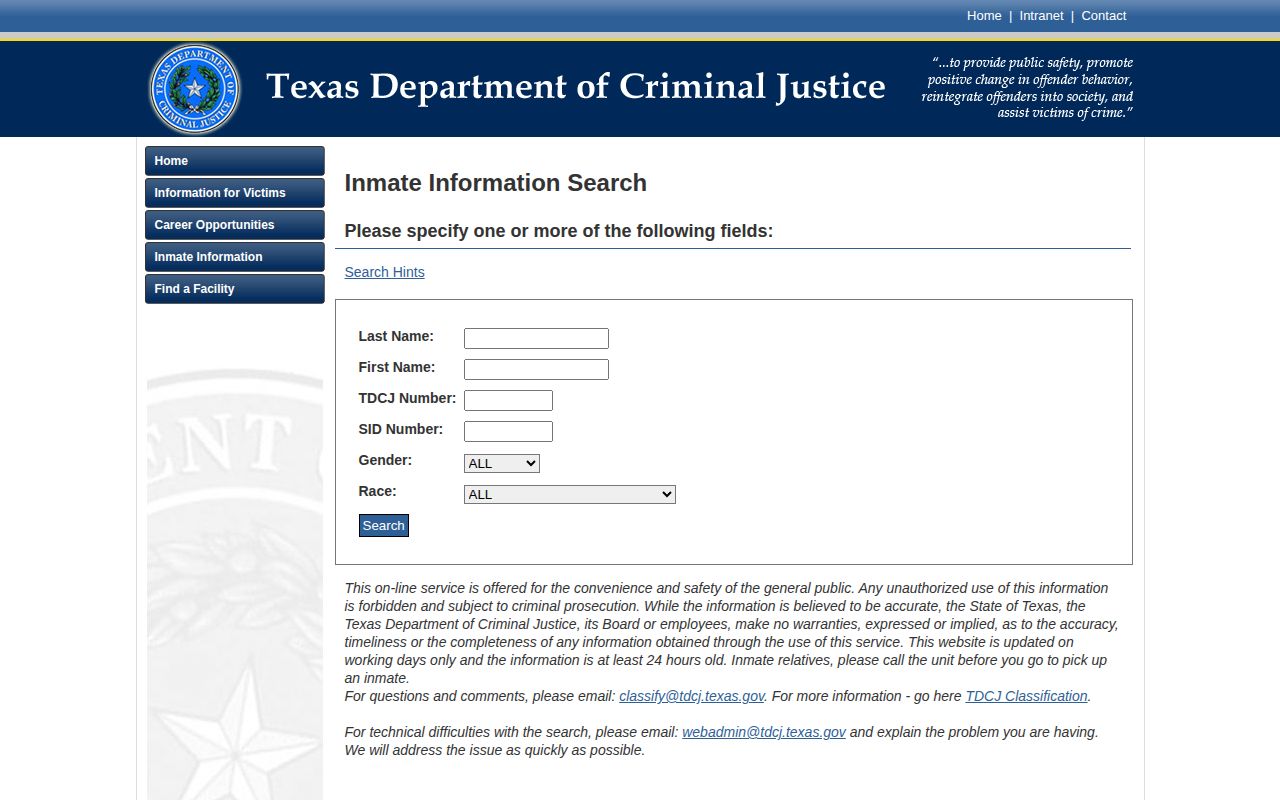
The search screen supports names and state identifiers. It must be paired with the exact offender detail, not treated as a county release list.
After a favorable release decision, TDCJ Classification and Records audits the file and calculates a scheduled date. TDCJ material describes roughly 14 to 21 business days for that stage in the stated process. Even a scheduled date can change on the day because of an audit, hold, warrant, order, or transport issue. The completed release record is the after-the-fact proof.
TDCJ Email and Phone Records
TDCJ provides a no-charge inmate-information email channel at its official information page. Send the full name and seven-digit TDCJ number. If the number is unknown, include exact date of birth or approximate age and Denton County as the county of conviction.
The service can provide the TDCJ number, location, current and prior incarceration, offense, conviction-court information, and projected release date. It does not provide photographs or Social Security numbers through that channel. TDCJ also publishes telephone information routes and main numbers, including 936-295-6371 and 800-535-0283.
TDCJ Inmate Information
System: Texas Department of Criminal Justice
Email: pia@tdcj.texas.gov
Main numbers: 936-295-6371 / 800-535-0283
Best identifiers: Full name plus TDCJ number or SID
Scope: State custody, release-date, incarceration, and offense fields
Request a TDCJ Release Record
If the public detail does not adequately describe a former offender, submit a focused Public Information Act request to TDCJ. Identify the person with TDCJ or SID number, full name, date of birth where appropriate, Denton conviction, and a narrow date range. Ask for incarceration and release history, release date and type, unit of release, and parole, mandatory-supervision, or discharge status.
Request existing fields and documents. Texas agencies do not have to answer broad questions, conduct legal research, or create a custom narrative. Protected information may be withheld or redacted. The basic email channel should be tried first for the enumerated public fields because it is direct and free.
For the Denton County booking that preceded state commitment, use DCSO PublicAccess and GovQA instead. A TDCJ record cannot certify the precise county transfer transaction, while DCSO cannot certify a later state release.
Where TDCJ Releases Go
A person can leave a TDCJ unit on parole, mandatory supervision, or discharge. Parole and mandatory supervision continue legal custody and conditions in the community. A discharge or maximum-expiration event is different. The offender may also face a detainer, warrant, another sentence, or federal or immigration action that changes the destination.
| TDCJ outcome | Likely next record | Verification point |
|---|---|---|
| Parole | Parole Division supervision | Office routing and status |
| Mandatory supervision | TDCJ and BPP records | Approval, release, and current supervision |
| Discharge | Classification and Records history | Completed discharge date and type |
| Transfer or detainer | Receiving agency | Named destination and current custody |
The approved residence can determine the parole office. A Denton conviction does not guarantee supervision through Denton. Use the official Region II directory and TDCJ routing rather than assuming the conviction county controls.
Denton Parole After TDCJ
The Texas Board of Pardons and Paroles decides parole matters, while TDCJ Parole Division supervises people after release. A favorable vote is not immediate physical release. Conditions, a certificate, file audit, scheduled date, and unit processing can remain.
For post-vote status, BPP materials identify TDCJ Review & Release Processing at 512-406-5202. For supervision routing, use the Region II directory and provide the TDCJ or SID number. Private residence details, appointment schedules, and sensitive case plans are not assumed public.
The Denton post-release supervision record path separates parole from county probation. Probation can arise from a Denton court without state imprisonment and must be verified through the judgment and CSCD, not the TDCJ search.
TDCJ Good Time Limits
TDCJ good-conduct time is governed by Texas Government Code Chapter 498. It does not shorten the judicial sentence itself. Its effect depends on parole and mandatory-supervision eligibility, offense date, credits, and Board action. Texas has no universal rule that every offender serves a fixed 85 percent.
- Flat time
- Calendar time actually served.
- Good-conduct time
- State credit applied under the governing release framework.
- Maximum expiration
- The sentence endpoint shown by TDCJ's current calculation.
- Mandatory supervision
- A supervised release process whose rules depend on offense date and eligibility.
County-jail good time under Article 42.032 is a separate calculation and should not be applied to a TDCJ sentence. The Denton inmate release date page sets the county and state rules side by side.
Confirm Completed TDCJ Release
A sound conclusion names the custodian and the event. “Released from TDCJ on parole” is different from “discharged from the sentence.” Confirm the completed state event, then check Parole Division if supervision continues. If a detainer or receiving agency appears, verify that destination.
The broader Denton County released-inmate search explains how the original jail booking and court judgment connect to later state records. Keep the booking, commitment, state confinement, supervised release, and discharge stages in order.
Note: Record the TDCJ number, exact field label, source access time, and later completed event before describing a state release.