
Denton Release Dates by Custodian
Denton County Jail holds pretrial detainees, people serving county sentences, and people awaiting transfer. A person who has not been sentenced may leave on bond, a court order, dismissal, or transfer, so there may be no fixed future release date. For a county sentence, the judgment, jail credit, and DCSO computation control.
TDCJ dates apply only after commitment to the state system. A Denton conviction does not place the person in a Denton prison, and no TDCJ unit is listed in Denton County. Federal dates come from BOP and federal court records. Do not use a TDCJ projection for a county detainee or a county roster for a state prisoner.
| Custody class | Starting source | Date to seek |
|---|---|---|
| Pretrial county or city | Jail and court case | Bond or signed release order, then physical exit |
| Sentenced county | Judgment and DCSO records | Calculated county release date |
| TDCJ state inmate | TDCJ offender detail | Eligibility, projected, maximum, then scheduled |
| Federal inmate | BOP Locator and PACER | Federal release date and court supervision terms |
Find a Denton Release Date
Identify the present custodian before searching. A person absent from DCSO might have been released, transferred to TDCJ, moved to another jail, or taken into federal or immigration custody. Use at least two identifiers, such as full name plus booking, SID, TDCJ, or case number.
- Search Denton PublicAccess for the county booking and linked court case.
- Determine whether the person is pretrial, serving a county sentence, or transferred.
- For state custody, open the TDCJ offender search and match the exact record.
- Record parole eligibility, projected release, maximum sentence, current facility, and status.
- Use TDCJ email or phone when the online detail is absent or unclear.
- Seek the later scheduled date and unit of release after approval and file audit.
- Confirm completed release through the final agency record or notification plus the official record.
For a county sentence, obtain the signed judgment and ask DCSO for the calculation or final release sheet. For a pretrial case, monitor the bond or release order and confirm physical processing with the jail.
TDCJ Denton Release Date Fields
The TDCJ detail view uses exact labels that should not be collapsed into one date. Compare offense, conviction county, sentence, SID or TDCJ number, and identity before relying on the dates.
| TDCJ field | Meaning |
|---|---|
| Parole Eligibility Date | The date discretionary parole consideration can begin under applicable law |
| Projected Release Date | Classification and Records' current projection if parole does not occur sooner |
| Maximum Sentence Date | The sentence endpoint currently shown by TDCJ |
| Scheduled Release Date | A later operational date posted after approval, certificate, and file audit |
| Actual release | The completed departure recorded after processing |
The pictured TDCJ inmate-information page defines the projected date and provides an alternate request channel.
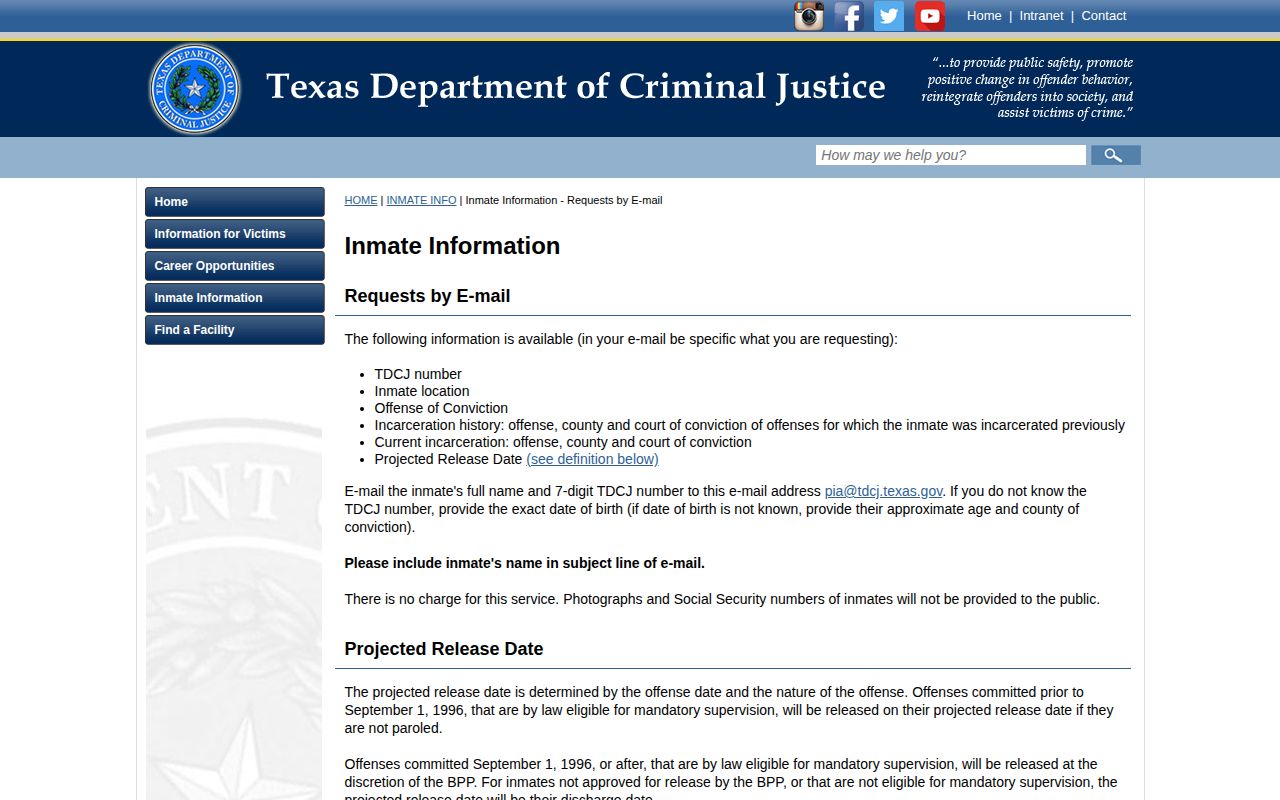
The page also explains which public fields can be requested without charge and states that photographs are not provided through that basic email service.
Denton Scheduled Versus Actual Release
A projected date is a current calculation, not a promise. Parole eligibility is even earlier in the sequence because it marks possible consideration rather than approval. A favorable BPP action can lead to conditions, a release certificate, records audit, and then a scheduled date. TDCJ materials say that later processing can take roughly 14 to 21 business days in the described process, and the scheduled date may change even on the day.
For Denton County Jail, a signed order likewise can precede physical exit. Staff may still process identity, bonds, holds, property, and transport. Pair the court order with the jail timestamp.
Texas Has No Blanket 85% Rule
Texas does not impose one universal rule that every inmate serves 85 percent of a sentence. TDCJ computations depend on the offense, offense date, parole and mandatory-supervision eligibility, good-conduct time, Board action, and maximum expiration. Some offenses have special eligibility limits. A percentage taken from the sentence alone can be wrong.
Government Code Chapter 508 governs parole and mandatory supervision. Section 508.145 addresses parole eligibility, while Sections 508.147 through 508.149 address mandatory supervision and exclusions. For eligible offenses before September 1, 1996, flat time plus good time can establish a mandatory-supervision point. For eligible later offenses, Board approval is also required. A denial may move the displayed projection to maximum expiration.
TDCJ good-conduct time is governed separately by Government Code Chapter 498. It does not shorten the judicial sentence itself. Its effect depends on the applicable release framework.
Denton County Jail Good Time
County-jail commutation follows a different law from TDCJ good time. Texas Code of Criminal Procedure Article 42.032 permits a sheriff to grant commutation for good conduct, industry, and obedience. The deduction may not exceed one day for each day of the original sentence actually served when no misconduct charge is sustained. The word “may” is important.
Denton's classification calculation, judgment, jail credit, disciplinary record, and court terms control the actual county date. Do not apply the maximum statutory rate automatically. A pretrial detainee also should not be assigned a county-sentence date without a sentence.
- Flat time
- Calendar time actually served toward the sentence.
- Good time
- Credit governed by the applicable county or state law and agency calculation.
- Jail credit
- Time the court credits in the signed judgment or later order.
- Maximum expiration
- The sentence endpoint shown by the controlling records, subject to lawful calculation.
Why Denton Release Dates Change
Future dates change because the legal and operational inputs can change. The source should be rechecked close to the expected date.
| Change | Possible effect | Record to verify |
|---|---|---|
| Good-time gain or loss | Changes an eligible calculation | DCSO or TDCJ classification record |
| BPP decision or condition | Moves or delays state release processing | BPP and TDCJ status |
| New warrant or detainer | Can cause continued or transferred custody | Movement log and receiving agency |
| Court order or sentence correction | Changes legal authority or credit | Signed court order |
| File audit | Changes a scheduled state date | TDCJ Classification and Records |
| Revocation action | Can return a supervised person to custody | Parole or court revocation record |
A release notification can provide a timely lead. The Denton County inmate release notifications path explains IVSS and TDCJ channels, but the final custody record remains controlling.
Denton TDCJ Alternate Requests
TDCJ's no-charge email path asks for the full name and seven-digit TDCJ number. If the number is unknown, provide exact date of birth or approximate age and county of conviction. The service can return location, offense, incarceration history, current incarceration, and projected release information. Telephone requests provide another official channel.
If a former inmate no longer produces an online detail, submit a precise Public Information Act request for incarceration, release, and discharge history. Include the TDCJ or SID number and date range. Ask for release date, release type, unit of release, and supervision or discharge status rather than a broad file.
For Denton county custody, use DCSO's GovQA portal instead. The state cannot certify the exact minute DCSO ended a county booking, and DCSO cannot certify a later TDCJ discharge.
Confirm Denton Actual Release
After the expected date passes, look for the completed agency event. A county release sheet should state release date and time, type, authority, holds, and destination. A TDCJ record should distinguish parole or mandatory supervision from unconditional discharge. A BOP result saying Released or Not in BOP Custody establishes departure from BOP only.
If the record states transfer, search the receiving custodian. If the release was on supervision, use the Denton parole or probation path to verify the status. If no public result appears, request the record rather than guessing. Sealed, expunged, juvenile, or confidential material may be restricted.
A final confirmation should preserve the source label, date, time, and identifier. If PublicAccess, a court docket, and a receiving agency appear to conflict, compare which stage each one records. The court may show authority, the jail may show movement, and TDCJ may show later state custody. They can all be accurate about different stages. Ask the originating office to correct its own record rather than treating a later database as the custodian of an earlier event.
Release certificates and discharge documents also differ. Parole and mandatory supervision continue legal supervision after confinement. A discharge record shows that the applicable sentence or supervision has ended. Use the exact agency term and date instead of calling both outcomes a simple release.
Note: Record the source and access time each time a projected, scheduled, or completed release date is checked.