
Denton Parole and Probation Differ
TDCJ Parole Division supervises people released from Texas state prison on parole or mandatory supervision. The Texas Board of Pardons and Paroles makes release decisions. Denton County Community Supervision and Corrections Department handles probation ordered by a court. A person may receive probation without entering TDCJ, and someone released on bond remains in a pretrial case rather than automatically becoming a probationer or parolee.
| Point | Parole | Probation |
|---|---|---|
| Starting event | Conditional release from state confinement | Court orders community supervision |
| Main authority | BPP decision and TDCJ records | Sentencing court and CSCD |
| Public starting record | TDCJ offender detail and BPP status | Judgment or community-supervision order |
| Local routing | TDCJ Denton District Parole Office | Denton County CSCD and sentencing court |
| Proof of ending | TDCJ discharge or supervision record | Termination, completion, or discharge order |
- Parole
- Conditional release from incarceration before the maximum sentence date, under state supervision.
- Probation
- Court-ordered community supervision that can be imposed instead of or after confinement.
- Mandatory supervision
- A statutory form of supervised release whose availability depends on offense date, eligibility, credits, and Board review.
- Discharge
- The documented end of the sentence or supervision status, not merely the passage of time.
Verify Denton Post-Release Supervision
First decide whether the person was released from Denton County Jail or from TDCJ. County release records can show bond, time served, court order, transfer, or another event, but they do not by themselves establish state parole. A TDCJ number, SID, state facility, and BPP action point to the state-prison path. A local judgment imposing community supervision points to probation.
- Match the person with full name and a TDCJ, SID, booking, or case number.
- For state custody, search the TDCJ inmate system and record status and date fields.
- Read the BPP decision or vote code without treating a favorable vote as completed physical release.
- Contact Parole Division with the TDCJ or SID number for allowable supervision and office routing.
- For probation, open the Denton sentencing case and obtain the signed judgment or supervision order.
- Seek a later termination, revocation, completion, or discharge order before stating that probation ended.
Texas has no verified public universal probationer locator comparable to the BOP Locator. Court and CSCD routing are therefore essential. A docket entry is a useful index, but a signed order supplies the exact terms.
Denton District Parole Office
The official TDCJ Region II directory lists the Denton District Parole Office. The live directory is the proper source for its current address, phone number, counties served, and office routing. Use it rather than an old directory copied elsewhere because assignments and contact details can change.
Denton District Parole Office
Agency: TDCJ Parole Division, Region II
Service: State parole and mandatory-supervision routing
Directory: Official Region II district parole office page
Useful identifier: TDCJ or SID number
The conviction county does not always determine the supervision office. TDCJ may route supervision according to the approved residence, and that residence may be outside Denton County. Office staff may confirm public status or route a proper inquiry, but supervision addresses, appointment schedules, and sensitive case plans are not presumed public.
The pictured Denton office directory shows the official state routing source.
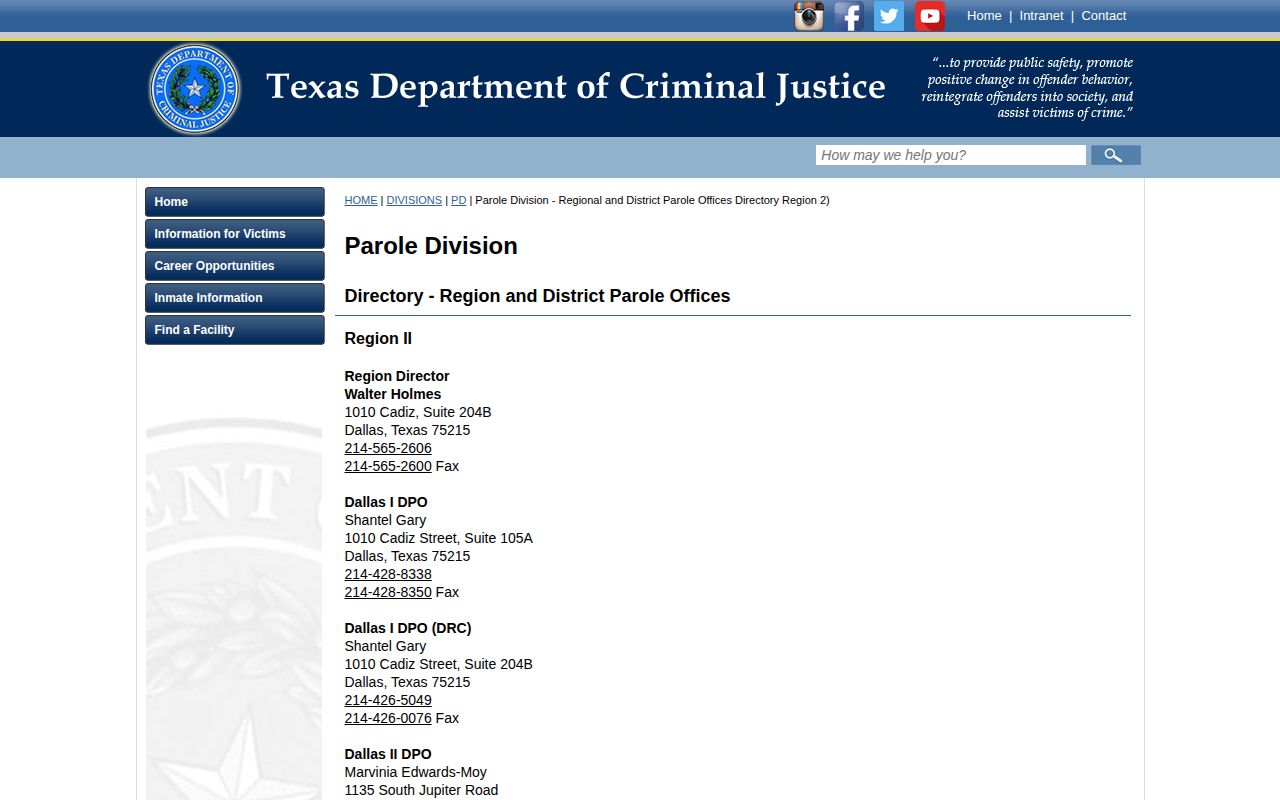
That directory should be checked at the time of contact because a static page copy cannot establish a current assignment.
Denton Probation Record Path
For probation, search the sentencing case rather than a jail roster. Felony cases route through the Denton County District Clerk, while statutory county criminal courts maintain misdemeanors through the County Clerk. Class C cases may be in a municipal or justice court. Use the case number because one name can be attached to several cases with different outcomes.
The judgment shows whether community supervision was imposed. Later entries may reflect modification, early termination, revocation, completion, or discharge. Do not infer successful completion because the original term appears to have elapsed. Obtain the signed later order. Sealed, juvenile, expunged, and otherwise confidential records may produce no public result.
A person can also return to custody on a probation revocation matter. In that situation an older order still proves the original probation, while the new warrant, detention event, and revocation order explain the current status. Compare dates and case numbers instead of treating either record as the whole history.
Denton Warrants and Absconders
An absconder is a person alleged to have stopped reporting or whose whereabouts are unknown under the applicable supervision process. Public specialty searches do not form a complete parole or probation warrant list. TDCJ offers a Sex Offender Absconder Information Search, and the Texas DPS registry can report status for people who are legally required to register. That scope is narrow.
A Denton County warrant search may show an active warrant, but publication can lag and operational limits apply. Direct agency confirmation is required before relying on it. A “blue warrant” commonly refers to a parole-revocation warrant. An arrest on such a matter means the person may be back in custody even while an older record still describes parole.
| Result | What it supports | What it cannot prove alone |
|---|---|---|
| TDCJ parole status | Recorded state supervision status | Present physical location |
| Specialty absconder hit | A listed specialty status | Universal warrant status |
| County warrant entry | Published Denton warrant information | Real-time execution or custody |
| New jail booking | A new custody event | Final revocation outcome |
Denton Supervision Conditions and Violations
Conditions are enforceable requirements in the release certificate, supervision plan, judgment, or court order. They may address reporting, travel, treatment, fees, residence, contact, or conduct, but the exact terms must come from the person's controlling record. General descriptions should not be used to guess an individual condition.
An alleged violation does not automatically establish revocation. For parole, TDCJ and BPP records distinguish the warrant, hearing, decision, and return-to-custody stages. For probation, the court record may show a motion to revoke or adjudicate, an arrest, a hearing, and a signed order. The final order controls the legal outcome.
Texas IVSS-Counties can send county custody or court-event notifications when the record and event are supported by the participating feed. It is not the supervision ledger. A notification failure also does not prove that no custody change occurred. Verify the jail event, TDCJ record, or court file directly.
How Denton Supervision Ends
Parole or mandatory supervision ends through a documented state action, often at discharge or maximum expiration under the applicable sentence and rules. A projected date, parole eligibility date, or favorable BPP vote is not a completed discharge record. TDCJ Classification and Records or Parole Division is the correct source for state status.
Probation can end through completion, early termination, revocation, or another signed court order. The original judgment is not proof of what later happened. Ask the appropriate Denton clerk for the termination or discharge order by cause number. If the public search returns nothing because a case is sealed or expunged, describe that as no public result.
The Denton County released-inmate search and records path explains how the underlying county release sheet and court order work together. Those records answer when county custody ended; the later supervision record answers whether legal supervision continued.
Note: Parole or mandatory supervision continues state legal custody after prison release, while discharge marks a different and later status.
Property After Denton Release
Post-release needs can overlap with supervision verification, but the records come from different offices. The DCSO Detention Bureau Support section expressly identifies an Inmate Property Unit alongside Booking/Release. A person released from county custody should use DCSO instructions for property that was not returned during processing.
City of Denton Jail has a separate rule. Its official page says a detainee may authorize another person with government photo identification to collect property. That recipient must accept all property except the detainee's clothing and prescribed medication. City staff can also identify the tow company at release when a vehicle was involved.
These city details should not be attributed to DCSO or TDCJ. Confirm the original custodian, then use its property channel. A parole office does not become the custodian of jail property merely because the person later reports there.